
Adding Mat Space to a Gym
Daniel Jurkowitsch, Founder, FlowSpace Mats
The short answer
How do gyms add mat space without building a permanent floor?
Gyms add mat space without construction by using mats that set up and pack away: roll-out foam, folding panels, or inflatable mats. Inflatable mats store smallest and go down fastest, so one floor can run a grappling class, then go back to fitness. A permanent mat build still suits a room used only for mat work.
Why not just build a permanent mat floor?
A permanent floor is the right answer for a room that only ever holds mat classes. It costs a build, though: a subfloor, foam tiles locked or glued down, and the time the room is closed while it goes in.
It also fixes the room to one use. If the same floor runs strength classes, open gym or kids programs, a permanent mat build takes that space away from them every hour of the week.
What are the portable options?
There are three, and each is right somewhere.
- Roll-out foam: no pump and stable underfoot, but heavy, bulky to store and slow to lay and lift across a big area.
- Folding panels: quick to move, but seams between panels and a thinner surface for throws and takedowns.
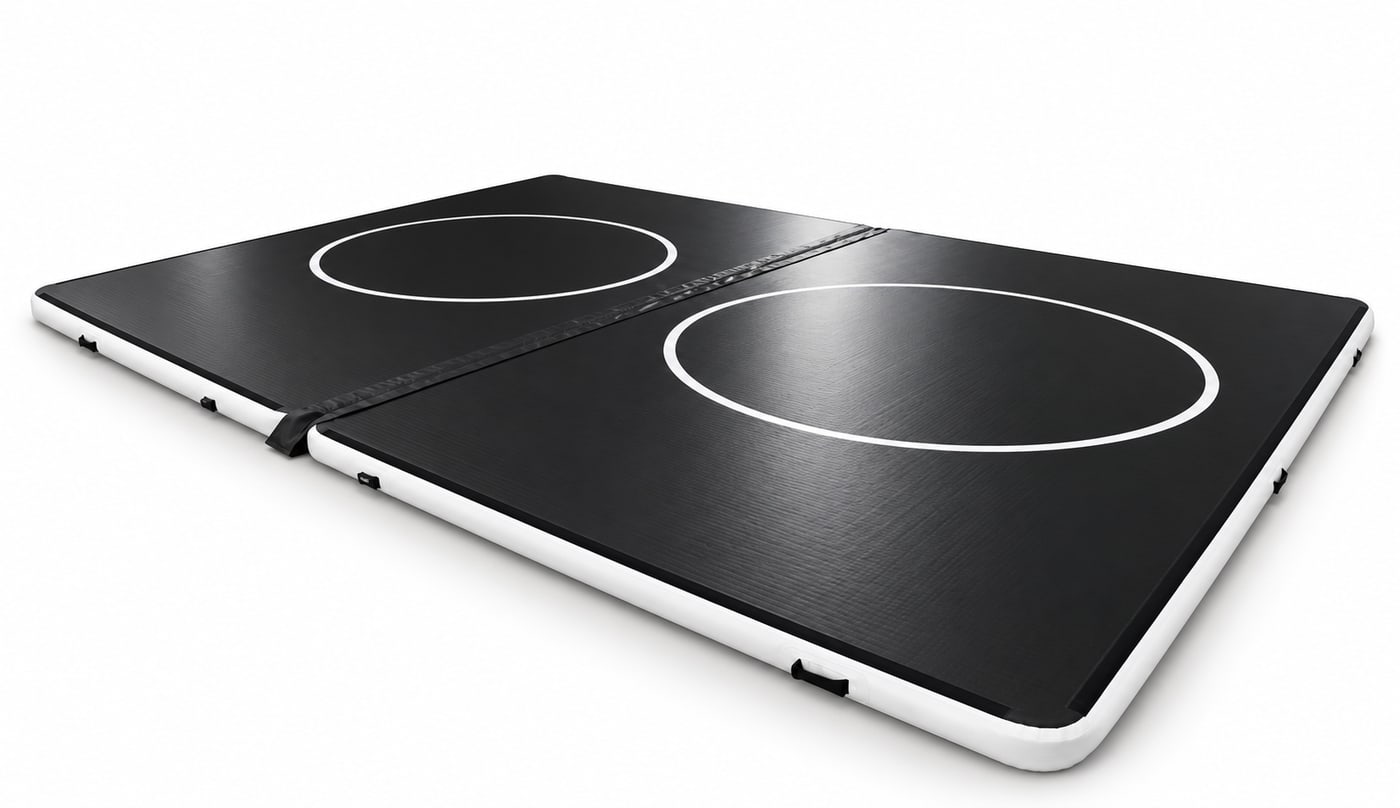
- Inflatable mats: a 4 inch surface that sets up in minutes and rolls into a duffle bag, at the cost of a different feel underfoot for standing work.
How much mat space does a class need?
Count the pairs that drill at the same time, then size the floor to them.
- Home FlowMat 10x10: a private lesson, a small group, or a drilling station beside the main floor.
- Pro FlowMat 10x16: a full class area, with several pairs drilling at once.
- Arena Bundle 20x16, two Pro mats joined: a continuous floor for a full class or an open mat.
What does it cost to add mats in bulk?
Wholesale pricing on orders of 5 or more: 20% off list (Home FlowMat 10x10 at $479.20 per mat). Below that, mats are sold online at list price.
Custom logo mats are available and made to order, so they take longer than stock mats. The lead time for your order is confirmed on the quote, before you commit.
How do you look after mats used every day?
Keep shoes and sharp objects off the surface, keep it at the pressure the care guide gives, and check the surface regularly. Every mat ships with a repair kit.
Between classes, clear debris, apply a mat-safe cleaner as directed in the care guide, wipe down, and let it air dry fully before it is rolled up. We do not publish compatibility claims for specific cleaning products, so ask us about a particular one.
When is an inflatable mat the wrong choice?
When the room is a mat room and will stay one. If nothing else ever uses the floor, a permanent foam build does not have to be set up or packed away, and it feels the same underfoot every class.
Standing work and throws feel different on an air-held surface than on dense foam. Run a few weeks of your own classes on one mat before you fit out a whole floor.
We make no impact-certification claim. These mats have not been tested to ASTM F355 or any equivalent standard.
Common questions
How many mats qualify for wholesale pricing?
Five or more in one order. Wholesale pricing on orders of 5 or more: 20% off list (Home FlowMat 10x10 at $479.20 per mat). Request a quote with your sizes and quantities.
Can we put our logo on the mats?
Yes. Custom logo mats are made to order, and the lead time for your order is confirmed on the quote before you commit.
How long does one mat take to set up?
About three minutes to inflate with the included electric pump, and a similar time to deflate and roll up.
Will the floor be usable for other classes afterwards?
Yes. Nothing is fixed down. Deflate the mats, roll them into their duffle bags, and the floor is back to what it was.
Last checked: .
Get Exclusive Training Tips & Deals
Join the FlowSpace community. Be first to know about drops.